
Sydney stone retaining wall
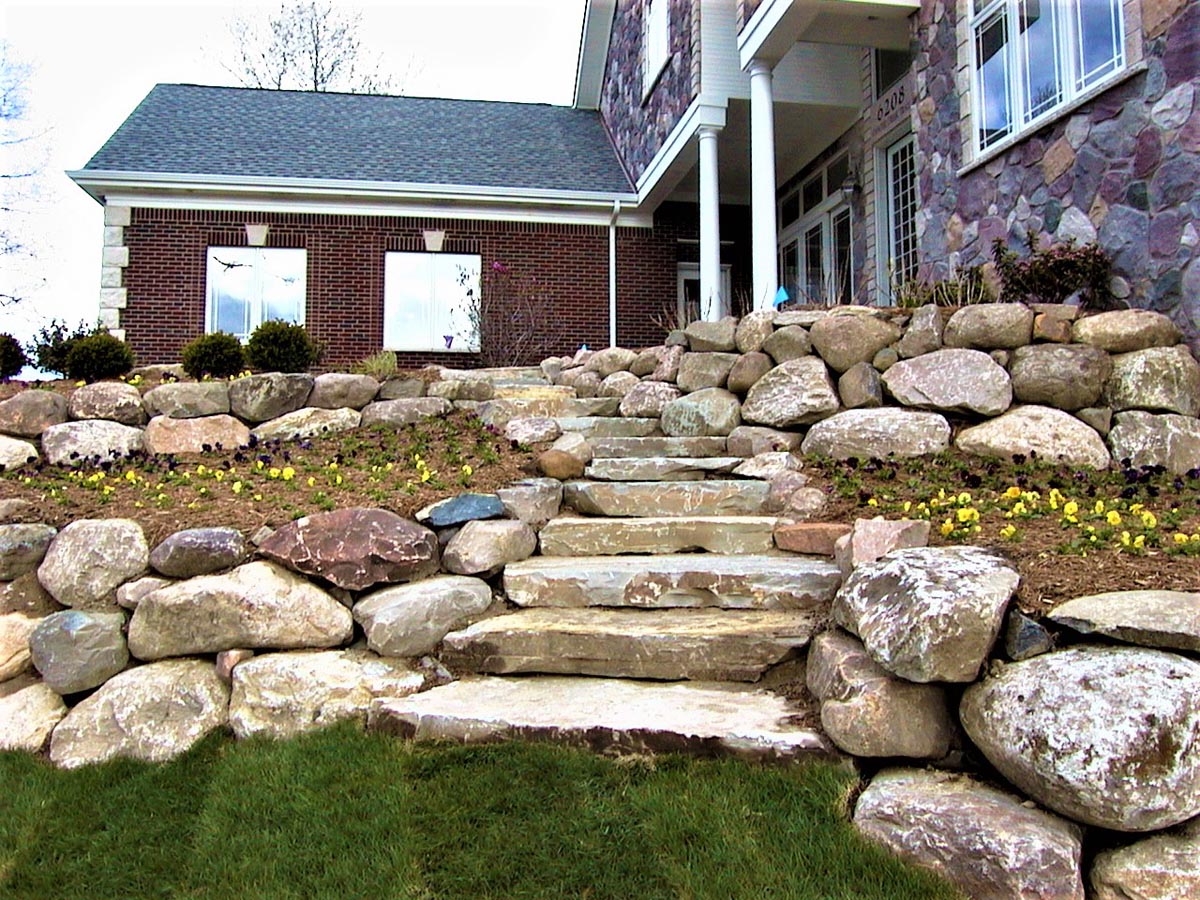
Sydney Stone Retaining Wall (Sandstone)
A Sydney Stone retaining wall, almost universally referring to the region’s iconic sandstone, is far more than a functional landscape feature. It is a signature element of Sydney’s built environment, deeply rooted in the city’s history and geology. From the heritage terraces of The Rocks to modern landscaping projects across the Northern Beaches and Sutherland Shire, sandstone has been the region’s premium building Best Materials for Retaining Walls in Sydney for generations.
Unlike generic concrete or timber options, a sandstone retaining wall offers a unique combination of immense structural strength, natural weathering beauty, and a timeless aesthetic that integrates seamlessly with Australian landscapes. This guide covers the specific types of sandstone retaining walls suitable for Sydney properties, their structural requirements, council regulations, and design considerations.
1. Natural Sandstone Block Walls (Gravity Walls)
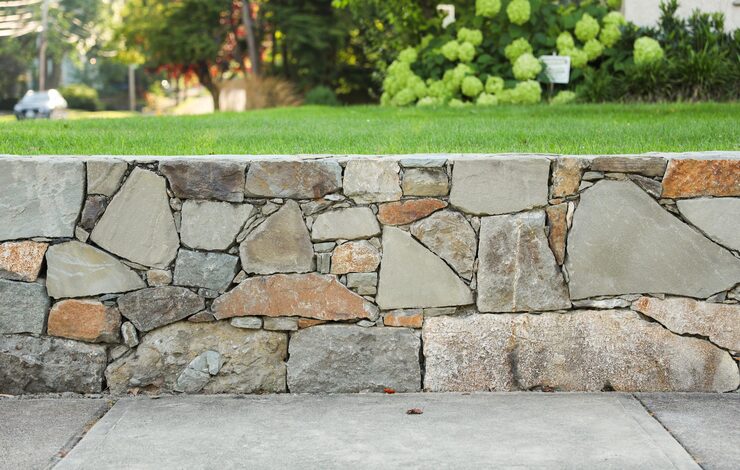
This is the most traditional and visually striking type of Sydney sandstone retaining wall. It consists of large, solid sandstone blocks, sometimes weighing hundreds of kilograms, stacked directly on top of one another without mortar or reinforcement .
How it works: These are gravity walls. The sheer mass and weight of the sandstone blocks (often 500mm to 1000mm in depth) resist the lateral pressure of the retained soil. A standard block size is approximately 1000mm long x 500mm high x 500mm deep, with larger 2000mm blocks available for heavier applications .
Aesthetic: Rustic, heritage, and commanding. The natural cleft faces, fossil impressions, and warm earthy tones (ranging from honey-gold to deep ochre) give each wall a unique character. This type is ideal for period homes (Federation, Victorian), bushland properties, and large-scale terracing where a natural look is desired .
Structural Requirements: Because they rely on mass, these walls require a wide, stable base. They typically have a slight batter (leaning back into the slope) – usually 1:6 (100mm setback for every 600mm of height) – to improve stability .
Drainage: While the gaps between irregular blocks allow some water to escape, gravity walls still require gravel backfill and agricultural drainage pipes to prevent hydrostatic pressure build-up.
2. Sawn & Dressed Sandstone Block Walls
For a more contemporary or formal aesthetic, sawn and dressed sandstone blocks offer a precision finish while retaining the material’s natural beauty. These blocks are cut with diamond-tipped saws to create sharp edges and uniform dimensions.
How it works: These can function as gravity walls (if blocks are large enough) or as facing units for a reinforced concrete structure. For walls exceeding 1.2 meters in height, sandstone is often used as a 100-150mm thick cladding or facing over a reinforced concrete core, combining structural efficiency with the beauty of natural stone.
Aesthetic: Clean, modern, and architectural. The ashlar pattern (uniform rectangular blocks laid in running bond) creates a sleek, geometric look suitable for contemporary homes, driveways, and formal entryways .
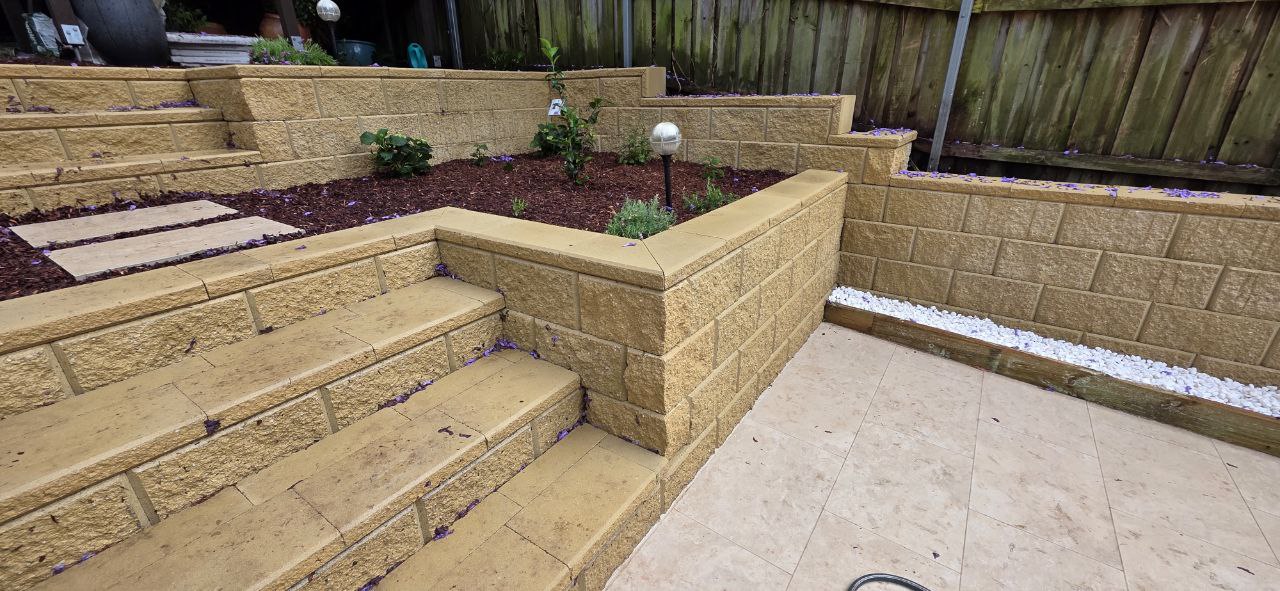
Applications: Ideal for split-level homes on Sydney’s sloping blocks, as it provides a crisp edge that contrasts beautifully with landscaping . It is also popular for steps, planter boxes, and letterboxes that match the retaining wall .
3. Segmental Sandstone Block Systems (e.g., MagnumStone)
While often thought of as “concrete,” modern segmental retaining wall (SRW) systems manufactured to look like sandstone offer a high-strength, mortarless alternative. Austral Masonry’s MagnumStone system, for example, was used extensively in the high-profile Barangaroo Headland Park project in Sydney .
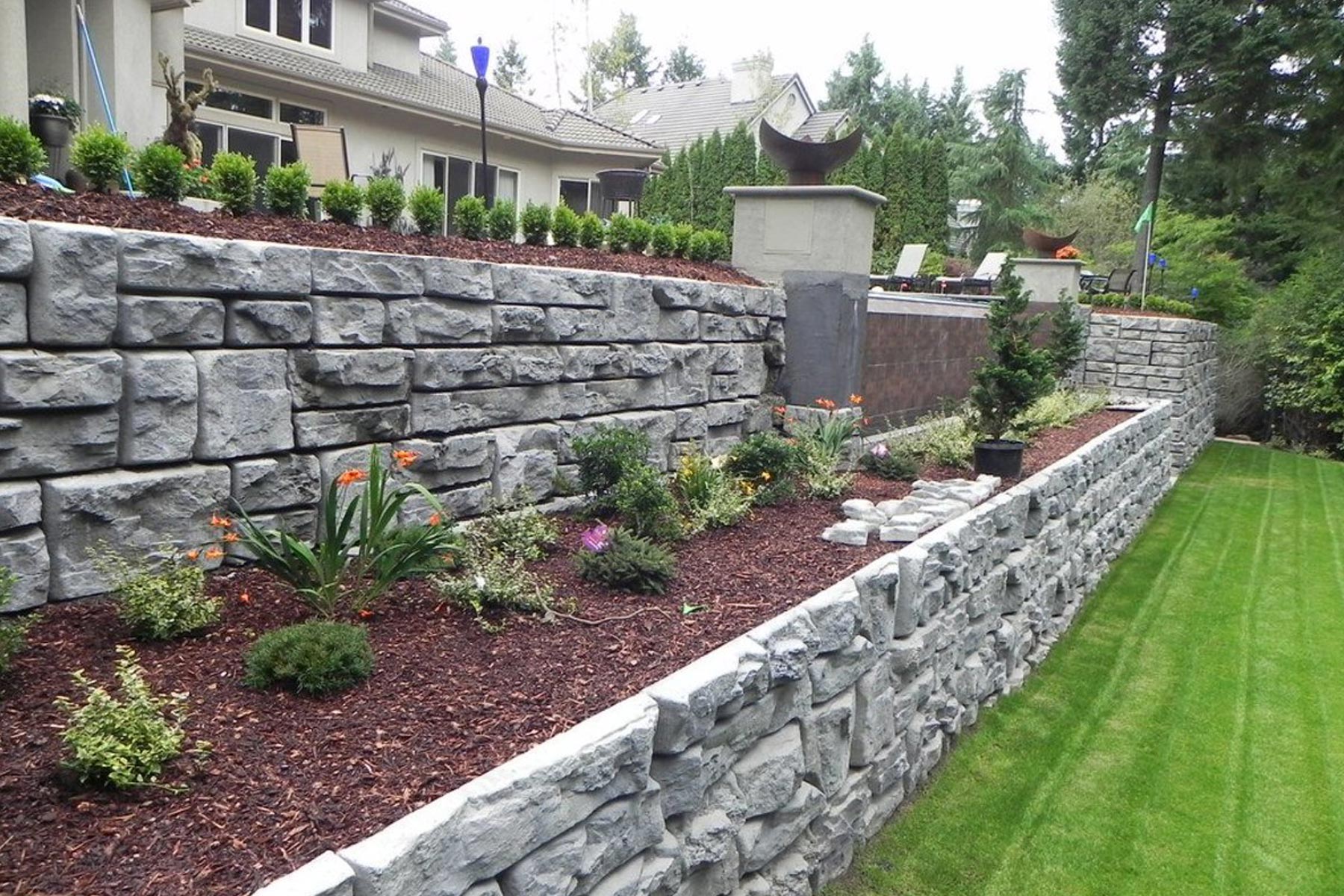
How it works: These are dry-stacked, hollow-core concrete blocks designed with a specific sandstone texture and colour. They are laid without mortar, with each course offset (stretcher bond). The hollow cores are filled with aggregate, increasing the weight and retaining capacity dramatically .
Structural Capability: Engineered for significant heights (well over 2 meters). They rely on a combination of mechanical interlock (often a shear lug or pin system), geogrid soil reinforcement, and the weight of the aggregate fill .
Aesthetic: Manufactured sandstone finish. While not “real” stone, high-quality units capture the texture and colour of Sydney sandstone exceptionally well. The Barangaroo project used these to create “plantable retaining walls” that integrated with native landscaping .
Advantage: Rapid installation. At Barangaroo, crews were laying up to 130 blocks per day (approx. 97 square meters) using an excavator boom, making it far faster than traditional mortar and stone masonry .
Key Considerations for Sydney Sandstone Walls
The Sydney Sandstone Classification System
Sydney sandstone is not a uniform material. Engineers and geologists classify it into five strength classes (Class I to V) based on its weathering and defects .
Class I & II: Fresh to slightly weathered, high-strength rock. This is the premium material found at iconic sites like the M2 tunnel and the cliffs at the Opera House .
Class III: Moderately weathered. Still suitable for retaining walls but with reduced strength parameters.
Class IV & V: Highly to completely weathered (sometimes resembling a sandy clay). This material is generally not suitable for structural retaining walls without extensive engineering treatment .
Tip: When sourcing “Sydney sandstone,” specify the intended structural use. A reputable supplier (like Sydney Sandstone Sales or Sandstone King) will provide A-grade or B-grade material suitable for load-bearing applications .
Council Regulations & Approval (Sydney-Specific)
Building a sandstone retaining wall in Sydney is subject to strict local council rules and NSW state regulations.
Development Approval (DA) or Complying Development Certificate (CDC):
Most retaining walls over 600mm (0.6m) in height require engineering certification and council approval, particularly in areas like Ku-ring-gai, Willoughby, or the Hills Shire where overland flow and slope stability are critical .
Boundary Walls:
If the wall is on or near a property boundary (common in terraced suburbs like Paddington, Balmain, or Glebe), you must comply with the Dividing Fences Act 1991.
Historical Areas:
In heritage conservation areas, such as The Rocks or parts of Parramatta, you may be required to use traditional gravity construction with specific mortar mixes (e.g., lime mortar) rather than modern reinforced concrete, to maintain historical integrity.
Sandstone as a Foundation Material (Geotechnical)
Interestingly, if you are excavating into a sloping block in Sydney, you are often digging into the sandstone itself. This presents a unique opportunity.
Rock Foundations: Sydney sandstone provides an excellent founding stratum for retaining walls. Unlike reactive clay soils found in other parts of Sydney (e.g., the Western Suburbs), a Class II or III sandstone foundation has high bearing capacity and low compressibility .
Optimizing Design: For larger projects, engineers can design precast cantilever walls founded directly on the sandstone rock. Instead of excavating out the rock to pour a deep concrete footing, the footing is keyed into the rock surface. This reduces concrete usage and excavation costs while creating a structurally superior wall .
Cost and Longevity
| Feature | Sandstone Wall | Concrete Sleeper Wall | Timber Wall |
|---|---|---|---|
| Lifespan | 50 – 100+ years (Indefinite) | 30 – 50 years | 10 – 25 years |
| Initial Cost | High ($$$$) | Moderate ($$) | Low ($) |
| Maintenance | Very Low (occasional repointing) | Low (sealing if painted) | High (replacement/rot) |
| Property Value | Significant Increase | Neutral | Neutral/Low |
While the upfront investment for a sandstone wall is significantly higher than timber or concrete sleepers (often 2-3x the price), it is a “build once” solution. A properly constructed sandstone retaining wall will outlast the house it sits beside and often adds more value to a Sydney property than the cost of construction .
Stonemasonry Finishes
The “look” of the wall is dictated by how the stone is worked:
Split-Faced (Riven): The natural, jagged cleavage plane. This looks the most organic and rustic.
Sawn: Smooth, flat surfaces with sharp 90-degree corners. Ideal for modern, precision landscapes.
Rock-Faced (Bochhammer): The face of the block is hammered to create a textured, dimpled surface while maintaining a straight perimeter. This offers a compromise between rustic and formal.
Hydrasplit: A mechanised splitting process that creates a clean, broken face that is sharper than riven but less uniform than sawn .
Summary: Which Type is Right for You?
Choose Traditional Gravity (Split-faced) if: You have a heritage home or bushland setting, want a rugged natural look, and have the space required for the wide base of a gravity wall.
Choose Sawn/Dressed Blocks if: You have a modern architectural home in suburbs like Mosman, Bondi, or Castlecrag, and require clean lines and formal edges.
Choose Segmental Systems (Sandstone look) if: You need a wall over 1.8m high, want rapid installation, or require a “plantable” wall system (as seen at Barangaroo) .
Choose Sandstone Cladding (over concrete) if: You want the look of sandstone on a very tall wall or a curved structure, but need the engineering certainty of reinforced concrete.