
The 4 Types of Landscape Design are formal, informal (naturalistic), native (ecological), and modern (geometric). Formal design uses symmetrical lines and clipped hedges for a structured look. Informal design embraces curved lines and organic shapes that mimic nature. Native design prioritises local plants that thrive in Sydney’s climate with minimal water. Modern design features clean lines, minimalist planting, and hardscape materials like concrete and stone.
1. Formal Landscape Design
What It Is
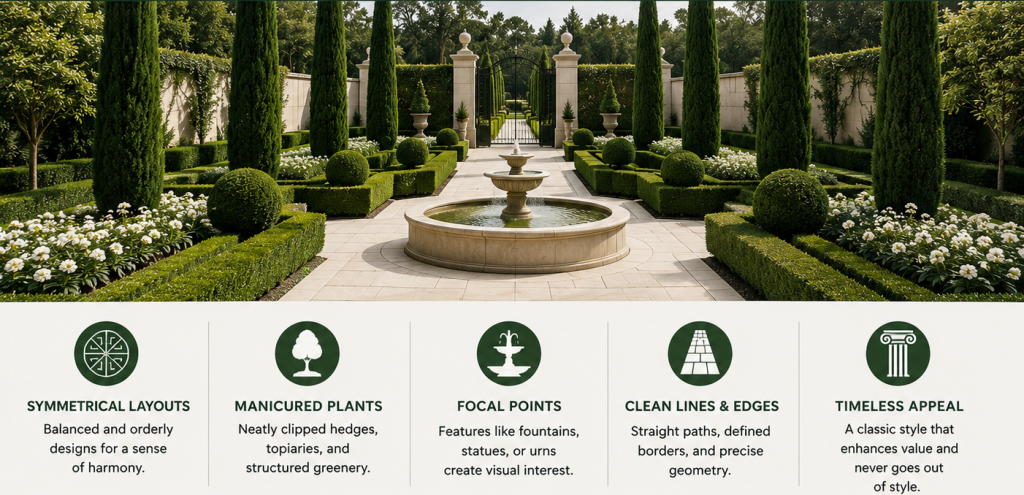
Formal landscape design is structured around symmetry, geometric shapes, and strict order. Plants are arranged in precise patterns, hedges are clipped neatly, and the design typically revolves around a central axis (a straight line running through the middle of the garden). Think of classic French or Italian gardens, Mughal gardens, or English estate grounds.
Key characteristics include:
- Straight lines and right angles
- Repetition of identical plants on both sides of a central path
- Clipped hedges (like box or murraya) and topiary
- Formal focal points such as fountains, statues, or urns
- Geometric bed shapes (squares, rectangles, circles)
Best Suited For
Formal gardens work best on larger blocks with level ground and classic or heritage-style homes. In Sydney, they suit suburbs like Woollahra, Vaucluse, Turramurra, and Mosman areas with Sydney Landscape architecture. Formal design can also work on smaller courtyards, but the scale must be carefully managed.
This style is not ideal if:
- Your block slopes significantly (keeping symmetry on a slope is difficult and expensive)
- You have limited time for maintenance (formal gardens require regular trimming, weeding, and care)
- Your home is ultra-modern (the contrast can feel disjointed)
2. Informal (Naturalistic) Landscape Design
What It Is
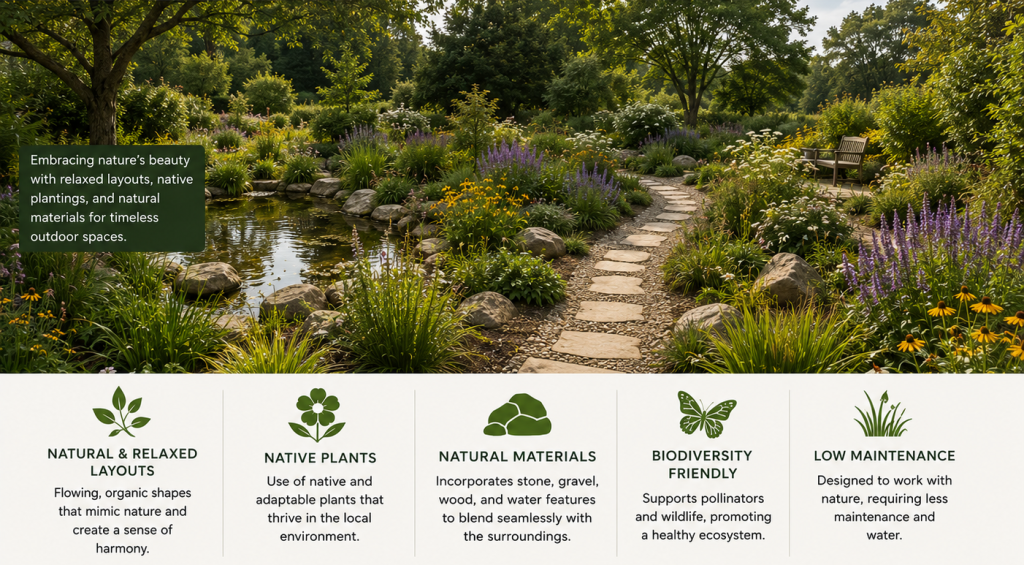
Informal landscape design is the opposite of formal: it uses curved lines, asymmetrical balance, and organic shapes to create a relaxed, natural feel. Rather than imposing strict geometry on the land, informal design works with the existing contours, using meandering paths, irregular plant groupings, and flowing bed lines.
Key characteristics include:
- Curved, flowing edges for garden beds and pathways
- Asymmetrical balance (different elements on each side that still feel visually equal)
- Plants allowed to grow in their natural form (not heavily pruned)
- Layered planting that mimics natural ecosystems
- Natural materials like stone, timber, and gravel
Naturalistic design draws inspiration from the English Landscape movement of the 18th century, which rejected the rigid geometry of French and Italian gardens in favour of “natural” compositions inspired by landscape paintings.
Best Suited For
Informal gardens work on nearly any block size or shape, but they particularly suit:
- Sloping properties (curved paths and terraces follow the land naturally)
- Bushland-fringe suburbs where the garden should blend with the surrounding native vegetation
- Homeowners who want a relaxed, low-pressure garden that doesn’t require constant perfect trimming
In Sydney, informal design is popular in the Hills District, Northern Beaches, and North Shore suburbs where properties back onto bushland.
Maintenance Reality Check
Naturalistic does NOT mean no maintenance. While an informal garden is less labour-intensive than a formal one, it still requires regular weeding (especially in the first three years), deep watering during establishment, and periodic pruning to prevent aggressive species from taking over. The phrase “sleep, creep, leap” applies the first year plants look like they are doing nothing while roots establish, the second year they grow, and the third year they flourish.
3. Native (Ecological) Landscape Design
What It Is
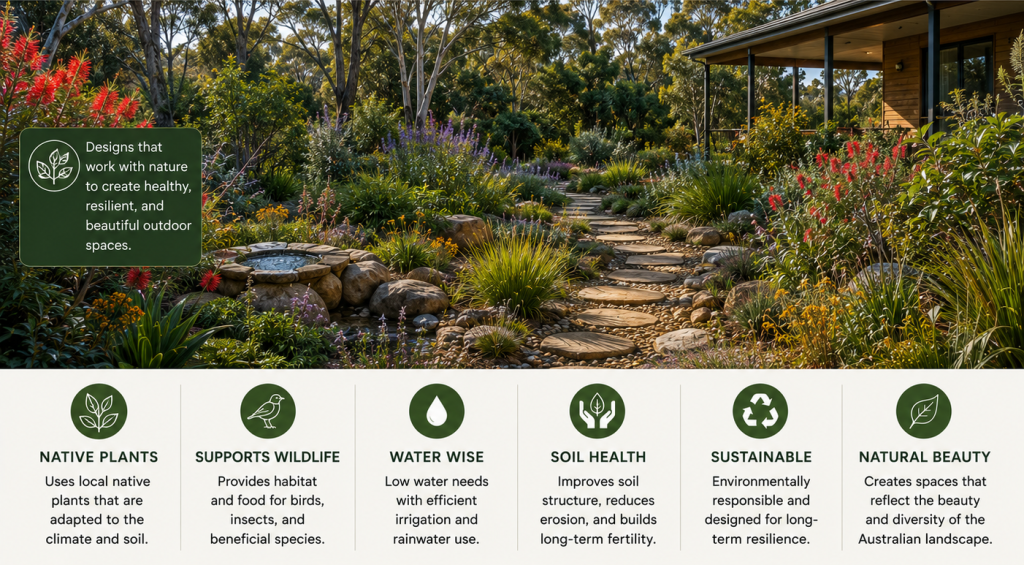
Native landscape design prioritises plants that have evolved naturally in your local area. In Sydney, this means using species like Westringia, Grevillea, Banksia, Lomandra, Kangaroo Paw, and Dianella plants that have adapted to Sydney’s clay and sandy soils, hot dry summers, and variable rainfall.
This style goes beyond just plant selection. It aims to mimic natural ecosystems using layered planting (groundcovers, shrubs, and trees), creating habitat for local birds, bees, and butterflies, and minimising water use, fertiliser, and chemical inputs.
Key characteristics include:
- 70–100% native plant species (preferably local provenance)
- Mulched beds to retain moisture and suppress weeds
- Water-wise design (drought-tolerant once established)
- Ecological function (wildlife habitat, stormwater absorption)
- Often combined with recycled or sustainable materials
Best Suited For
Native gardens are exceptionally well-suited to Sydney’s climate and are popular across the entire city. They work particularly well for:
- Homeowners who want very low water and maintenance needs
- Properties in bushfire-prone areas (with appropriate species selection and defendable space)
- Eco-conscious buyers (native gardens add appeal in Sydney’s property market)
- Any block size, from inner-city courtyards to sprawling suburban lots
Why native works in Sydney: The city has long, dry summers and periods of drought. Exotic plants often struggle without regular irrigation. Native plants have evolved to handle these conditions—once established, many survive on rainfall alone.
A Note on Bushfire Considerations
If your property is in a bushfire-prone area (much of Sydney’s interface with national parks), certain native species (like some eucalypts and Banksias) may need to be planted further from the house. A qualified landscaper can advise on lower-flammability natives and defensible space requirements.
4. Modern (Geometric/Minimalist) Landscape Design
What It Is
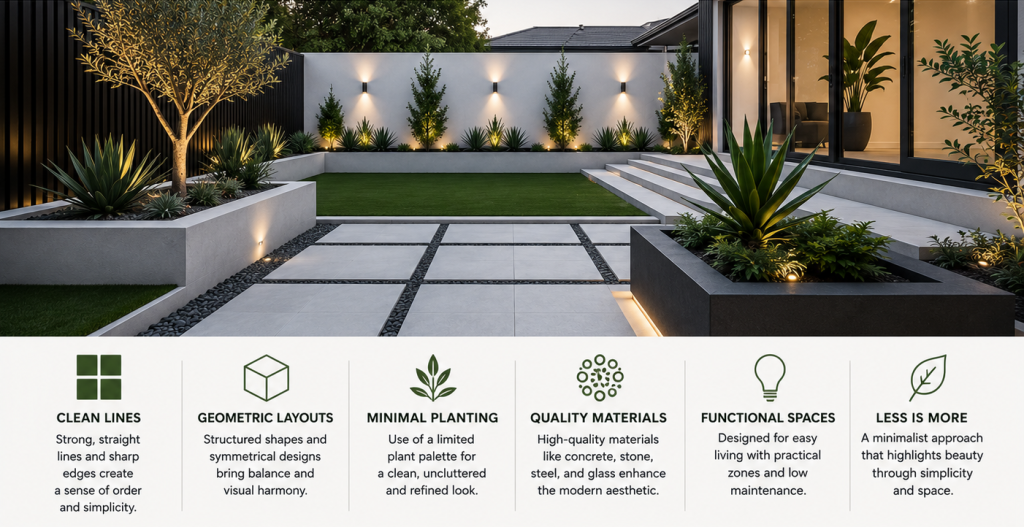
Modern landscape design emphasises clean lines, simple forms, and a deliberate use of hardscape materials. Unlike formal design (which uses symmetry and ornamentation), modern design is minimalist and often asymmetrical. It values negative space, sculptural plants, and seamless indoor-outdoor flow.
Key characteristics include:
- Straight lines and rectilinear shapes (but not necessarily symmetrical)
- Concrete, stone, or tiled paving (often large-format)
- Raised planter boxes with clean edges
- Sculptural plants like agave, grass trees (Xanthorrhoea), bamboo, or lomandra
- Limited lawn areas (sometimes none at all)
- Built-in lighting and integrated seating
Unlike formal gardens, modern design does not rely on repetition or classical ornamentation. A modern garden might have a single specimen tree in a sea of gravel, or a long concrete bench facing a wall of bamboo. The effect is deliberate, uncluttered, and calm.
Best Suited For
Modern design is ideal for:
- Inner-city homes, terraces, and duplexes where space is limited
- New builds and contemporary architecture (the garden mirrors the house)
- Courtyards and small spaces where every element needs to earn its place
- Homeowners who want a low-maintenance, high-style outdoor area
In Sydney, modern gardens are most common in Zetland, Alexandria, Waterloo, Barangaroo, and Rhodes—suburbs with high-density housing and contemporary apartment buildings. They are also popular for knock-down-rebuild projects across the city.
Maintenance Reality
Modern gardens are generally low-maintenance compared to formal or tropical styles, but they are not zero-maintenance. Paving needs occasional cleaning and weeding between joints. Sculptural plants still need watering while establishing and occasional pruning. Gravel areas need topping up and weeding over time.
Which Landscape Design Style Suits Sydney Homes Best?
There is no single “best” style for all Sydney homes—the right choice depends on your property’s specific conditions and your lifestyle. However, here are some local considerations.
Sydney’s Climate Favours Native and Modern Styles
Sydney’s hot, dry summers mean water-wise gardens perform better and cost less to maintain. Native gardens are the obvious winner here, but modern gardens with minimal lawn and efficient irrigation also work well. Formal gardens with large lawns and thirsty exotic plants will struggle without significant watering.
Sloping Blocks: Informal or Modern Terracing
Many Sydney properties (especially in the North Shore, Northern Beaches, and Hills District) are on slopes. Informal gardens that follow the land’s natural contours are often the most practical and cost-effective. However, modern terracing (stepped retaining walls with clean lines) can also work beautifully and add usable flat space.
Coastal Suburbs: Native or Coastal-Informal
If you live near the beach (Coogee, Manly, Cronulla, Bondi, Bronte), you need plants that tolerate salt spray, wind, and sandy soil. Native coastal species like Pigface, Coastal Rosemary (Westringia), and Banksias are ideal. A relaxed, informal style suits the coastal lifestyle stiff formal gardens feel out of place by the beach.
Heritage Areas: Formal or Traditional
In heritage conservation areas like Woollahra, Glebe, Paddington, and parts of Turramurra, council guidelines may encourage garden styles that complement the period architecture. Formal gardens or traditional cottage gardens are often more appropriate than stark modern designs. Check with your local council before committing to a style.
Matching Style to Architecture
A good rule of thumb: match the garden style to the house style.
- Victorian/Federation home → Formal or traditional cottage garden
- California bungalow → Informal or native
- Mid-century modern → Modern or native
- Contemporary new build → Modern or native
- Weatherboard cottage → Informal or native
Frequently Asked Questions(4 Types of Landscape Design)
Final Thoughts
Understanding the four types of landscape design is the first step to creating a garden that works for your Sydney home. Formal for heritage elegance, informal for relaxed flow, native for low-maintenance ecology, modern for clean-lined minimalism, each has its place, its strengths, and its maintenance realities.
The right choice depends on your property, your budget, and how you want to live outdoors. There is no wrong answer, but there is a smart answer for your specific situation.
If you are unsure which style suits your Sydney home, contact Sydney Landscaping Pty Ltd for a no-pressure site visit. We will walk through your garden, talk through your lifestyle, and recommend a style that makes sense for your budget and block. No jargon. No hard sell. Just honest advice from a team that knows Sydney soil, slopes, and styles.