
When planning a driveway, patio, walkway, pool deck, or garden path, you may hear the terms pavers and paving used almost interchangeably. However, they don’t actually mean the same thing. Understanding the difference can help you choose the right surface, estimate your budget, and avoid costly installation mistakes.
So, what is the difference between pavers and paving? In simple terms, pavers are individual units used to create a surface, while paving refers to the process, method, or finished surface created by placing paving materials. Pavers can be made from concrete, clay brick, natural stone, or other materials. Paving, on the other hand, can involve pavers as well as asphalt, concrete slabs, stone, or other surfacing systems.
That distinction sounds small, but it matters.
For example, a homeowner might say, “We’re installing pavers on the patio.” A contractor might say, “We’re paving the driveway.” Both statements can be correct, but they describe different aspects of the project.
This guide explains the difference in plain English and explores how the two terms relate to materials, installation, cost, durability, maintenance, drainage, appearance, and long-term value.
What Are Pavers?
Pavers are individual pieces of material designed to be assembled into a larger paved surface. Think of them like building blocks for your driveway or patio.
They can be manufactured in many shapes, sizes, colors, textures, and patterns. Common examples include concrete pavers, clay brick pavers, porcelain pavers, and natural stone pavers.
Unlike a single concrete slab, a paver surface consists of many separate units. These units are normally installed over a prepared base and joined with small gaps or joints.
The individual nature of pavers is one of their biggest advantages.
If one paver becomes cracked, stained, or damaged, you can often remove and replace that individual piece rather than demolishing the entire surface. That’s particularly useful in areas where underground utilities may eventually need access.
Common Types of Pavers
Several types of pavers are available, and each has different characteristics.
Concrete pavers are among the most popular choices. They’re manufactured in controlled shapes and sizes, making them relatively easy to arrange into patterns.
Brick pavers are made from fired clay and provide a traditional appearance. They’re often associated with historic streets, garden paths, and classic patios.
Natural stone pavers may be made from materials such as granite, limestone, sandstone, or slate. They offer natural variation and a premium appearance.
Porcelain pavers are manufactured for outdoor applications and can provide a modern, highly finished look. They require an appropriate installation system and shouldn’t simply be treated like ordinary indoor porcelain tiles.
Why Do People Choose Pavers?
Pavers are popular because they combine appearance and practical performance.
Their modular construction can provide several benefits:
- Individual units can be replaced.
- Many design patterns are possible.
- Colors and textures can be mixed.
- They can be used for driveways, patios, paths, and courtyards.
- Properly installed systems can handle substantial loads.
- Some systems can accommodate movement without developing one large structural crack.
However, pavers aren’t automatically better than every other paving material. Their performance depends heavily on the quality of the base, drainage, edge restraints, material selection, and installation.
In other words, good pavers installed badly can still produce a disappointing result.
What Is Paving?
Paving is a broader term.
It generally refers to the process of creating a hard, usable surface or the finished surface itself. Depending on the context, paving may involve concrete, asphalt, brick, stone, concrete pavers, or other materials.
That’s why the word “paving” shouldn’t automatically make you think of individual blocks.
For example, asphalt paving involves placing and compacting asphalt to create a continuous surface. Concrete paving may involve pouring a slab that hardens into one large surface. Paver installation involves assembling individual units over a prepared base.
So, while pavers are a type of paving material, paving is the broader activity or system.
Paving Can Mean Different Things
The word paving is commonly used in several ways.
A contractor might say they’re paving a driveway, meaning they’re constructing or resurfacing the driveway.
A homeowner might describe a patio as new paving, referring to the finished surface.
An engineer might discuss a pavement system, which can include several structural layers beneath the visible surface.
This broader meaning is important because the visible surface isn’t the entire pavement.
A professionally constructed paved area usually includes multiple layers. These can include the surface material, bedding material, base, subbase, and prepared subgrade.
Paving Is More Than the Surface
One common misconception is that paving is simply about choosing attractive material.
In reality, the foundation matters enormously.
A driveway that looks fantastic on installation day can develop settlement, rutting, ponding, or movement if the underlying ground isn’t properly prepared.
Factors such as soil type, drainage, expected traffic, climate, slope, and loading should influence the construction method.
The Concrete Masonry & Hardscapes Association provides technical resources on concrete pavers and hardscape construction that can be useful when researching a project. Concrete Masonry & Hardscapes Association
What Is the Main Difference Between Pavers and Paving?
The simplest explanation is this:
Pavers are individual paving units. Paving is the process or broader system of constructing a hard surface.
This distinction is similar to the difference between bricks and brickwork.
A brick is one individual unit. Brickwork is the finished construction created by assembling many units.
Likewise, a paver is one individual unit, while paving can describe the construction or finished surface.
Pavers Are a Material or Product
When someone talks about pavers, they’re usually talking about the physical units.
For example:
- Concrete pavers
- Brick pavers
- Stone pavers
- Porcelain pavers
These are products or units that can be installed to form a surface.
Paving Is a Process or Surface
When someone talks about paving, they’re generally discussing the act of constructing a paved area or the pavement itself.
Paving can therefore include:
- Paver installation
- Asphalt paving
- Concrete paving
- Stone paving
- Brick paving
That’s why asking, “Should I choose pavers or paving?” can sometimes be misleading. Pavers are one possible material/system within the wider category of paving.
Pavers vs. Paving: Quick Comparison
| Feature | Pavers | Paving |
|---|---|---|
| Meaning | Individual surface units | Process, method, or finished surface |
| Common materials | Concrete, brick, stone, porcelain | Asphalt, concrete, pavers, stone, brick |
| Construction | Usually modular | Can be modular or continuous |
| Repair | Individual units may be replaced | Depends on paving material |
| Design options | Very high | Depends on material |
| Drainage | Can be designed with joints or permeable systems | Depends on system |
| Typical uses | Patios, paths, driveways | Roads, driveways, patios, walkways |
| Installation | Unit-by-unit | Varies by material |
| Surface movement | Modular systems can accommodate some movement | Depends on construction type |
| Appearance | Many patterns and textures | Depends on material |
What Materials Are Used for Pavers?
Choosing pavers starts with understanding the available materials.
Concrete Pavers
Concrete pavers are manufactured to consistent shapes and sizes. They can be produced in many colors and patterns, making them a versatile option.
They’re commonly used for:
- Driveways
- Patios
- Walkways
- Pool surrounds
- Courtyards
- Commercial pedestrian areas
Their main appeal is the combination of durability, design flexibility, and relatively predictable installation.
Brick Pavers
Brick pavers have a classic appearance.
They can work particularly well with traditional homes, historic-style properties, gardens, and pathways. Their colour tends to develop character over time, although the exact appearance depends on the material and environment.

Natural Stone Pavers
Natural stone offers a distinctive appearance because each piece may have natural variation.
Popular choices include limestone, sandstone, granite, and slate.
Stone can be particularly attractive for premium patios, terraces, walkways, and landscaping projects. However, different stones have different levels of porosity, hardness, slip resistance, and weathering behaviour.
Porcelain Pavers
Outdoor porcelain pavers are designed for exterior applications and can imitate stone, wood, concrete, and other finishes.
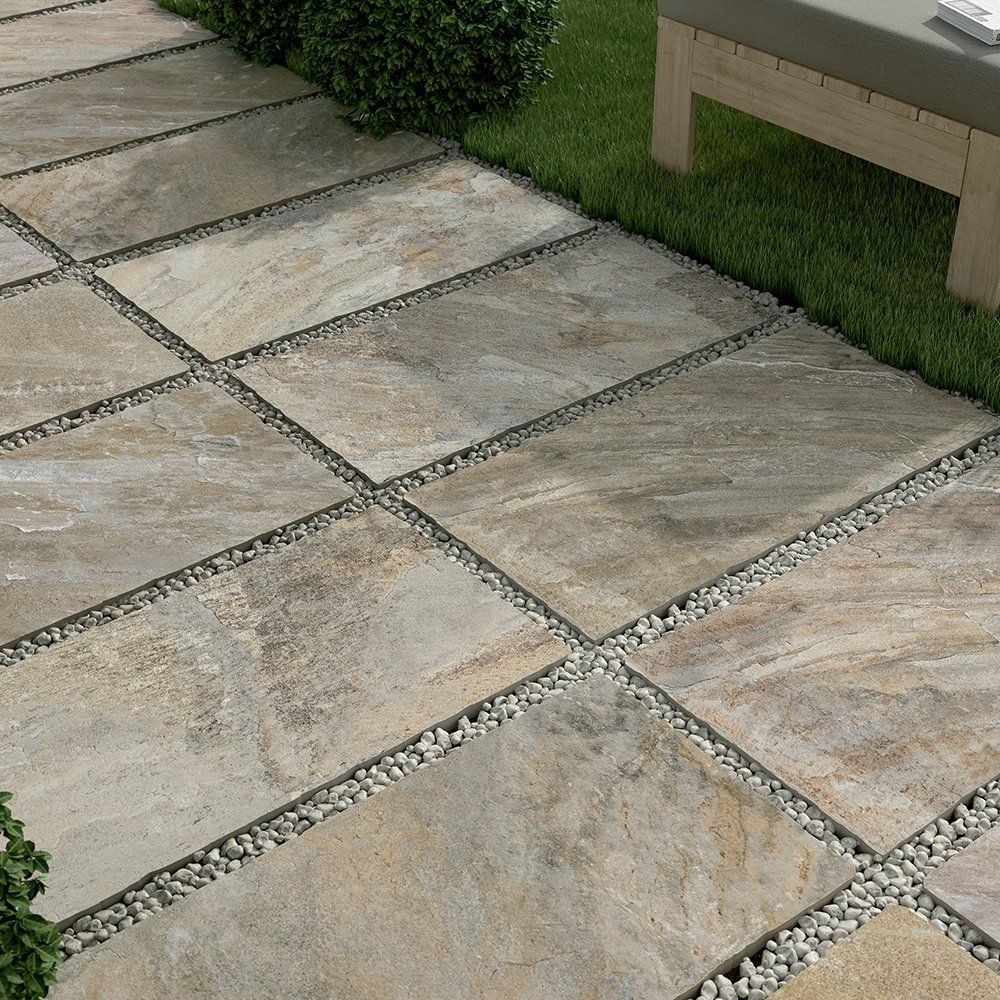
They’re often chosen for modern landscaping projects because they provide a clean, consistent appearance.
However, installation requirements can differ significantly from traditional concrete or brick pavers, so the manufacturer’s system should be followed carefully.
What Are the Main Types of Paving?
Because paving is a broad term, there are several major paving systems.
Asphalt Paving
Asphalt is widely used for roads, parking areas, and driveways.
It creates a relatively continuous surface and is particularly common where large areas need to be covered efficiently.
Concrete Paving
Concrete paving typically involves creating a slab or series of slabs.
Concrete can provide excellent structural performance when appropriately designed and installed. However, cracking can occur because concrete is a rigid material and is affected by ground movement, temperature changes, moisture, and other factors.
Paver Paving
Paver paving uses individual units assembled over a prepared foundation.
This approach can provide a highly decorative appearance while also allowing sections of the surface to be removed and reinstated when necessary.
Natural Stone Paving
Natural stone paving uses stone slabs or units to create outdoor surfaces.
It can be visually impressive, although installation costs and maintenance requirements vary significantly by stone type.
How Does Paver Installation Differ From Other Paving?
One of the biggest practical differences is how the surface is assembled.
With many paver systems, the contractor prepares the subgrade and base, adds a bedding layer, places the individual units, fills the joints, and compacts the surface.
The basic process may include:
- Measuring and marking the area.
- Excavating unsuitable material.
- Preparing and compacting the subgrade.
- Installing the required base.
- Establishing drainage and levels.
- Adding bedding material where specified.
- Installing edge restraints.
- Laying the pavers.
- Cutting units around edges and obstacles.
- Filling joints.
- Compacting the completed surface.
- Inspecting drainage, alignment, and finish.
The exact construction varies with the paver type, traffic level, soil, climate, and manufacturer’s specifications.
Why the Base Matters
A beautiful surface can’t compensate for a weak foundation.
For driveways and other heavily loaded areas, the base needs to be appropriate for the expected traffic and ground conditions.
Poor compaction can lead to settlement. Inadequate drainage can cause water-related problems. Weak edge restraint can allow units to spread or move.
This is where professional experience really counts.
Are Pavers More Expensive Than Other Paving Options?
There’s no universal answer.
The total cost depends on material, labour, site preparation, excavation, drainage, design complexity, accessibility, and local market conditions.
Pavers may have higher installation labour costs because individual units must be positioned and adjusted. However, their repairability can provide a long-term advantage.
For example, if a small section is damaged, individual units may be removed and replaced rather than replacing an entire slab.
Factors That Influence Paving Cost
Consider these factors when comparing quotes:
- Material price
- Excavation depth
- Soil conditions
- Base thickness
- Drainage requirements
- Edge restraints
- Labor
- Site accessibility
- Pattern complexity
- Cutting requirements
- Sealing requirements
- Removal of an existing surface
A low initial quote isn’t necessarily the cheapest option over the life of the project.
It’s smarter to compare the total installed value, not just the price per square meter or square foot.
Which Is More Durable: Pavers or Other Paving?
Durability depends more on the complete system than on the name of the material.
A properly designed and installed paver surface can provide excellent long-term performance. Asphalt and concrete can also perform extremely well when correctly designed and maintained.
Traffic loading is especially important.
A pedestrian garden path doesn’t need the same structural design as a driveway used by heavy vehicles.
Climate Also Matters
Freeze-thaw cycles, heavy rainfall, extreme heat, and expansive soils can affect paving systems.
In colder climates, water entering the pavement structure and subsequently freezing can contribute to movement or damage.
In hot climates, surface temperatures and thermal movement become important considerations.
That’s why local construction practices matter.
A paving system that works beautifully in one climate may require modifications in another.
What About Maintenance?
Maintenance varies according to material and installation.
Paver surfaces may require:
- Routine sweeping
- Weed control
- Joint maintenance
- Occasional cleaning
- Replacement of damaged units
- Periodic adjustment of settled areas
- Resealing where appropriate
However, not every paver system needs to be sealed.
Sealing is often a choice based on appearance, stain resistance, and manufacturer recommendations rather than an absolute requirement.
Paver Maintenance Advantage
The modular design can make certain repairs easier.
If a utility company needs to access a pipe beneath a paver driveway, the relevant section can potentially be removed and later reinstated.
With a continuous slab, cutting and patching may be necessary.
That’s one reason pavers are attractive for areas where future access could be important.
Do Pavers Provide Better Drainage?
They can, but it depends on the system.
Traditional pavers installed with conventional jointing materials aren’t automatically permeable. However, specially designed permeable interlocking concrete pavement systems can allow water to move through open joints and into the underlying pavement structure.
Permeable paving can be useful for managing stormwater, although it requires appropriate design, materials, maintenance, and site conditions.
Research into permeable pavement systems has examined their ability to manage runoff and pollutants.
Drainage Should Be Planned Early
Good drainage isn’t something to add as an afterthought.
Before installation, consider:
- Where will rainwater go?
- What is the existing slope?
- Is the soil suitable for infiltration?
- Are downspouts discharging near the paving?
- Could water flow toward the building?
- Is a drainage channel required?
- Will the local climate create freeze-thaw concerns?
A professional installer should evaluate these factors before construction begins.
Which Option Offers Better Design Flexibility?
Pavers usually have a major advantage when design flexibility is the priority.
Because individual units can be arranged in patterns, homeowners can create:
- Running bond patterns
- Basket-weave patterns
- Herringbone patterns
- Circular designs
- Borders
- Contrasting bands
- Mixed-color layouts
- Geometric patterns
The options are almost endless.
Matching Pavers to Your Property
The best design doesn’t necessarily use the most colours or patterns.
A simple layout with complementary colours can often look more sophisticated than a complicated design.
Consider the style of your home, surrounding landscaping, exterior walls, roof materials, and existing hardscape.
The goal is to make the paving look like it belongs there.
Are Pavers Easier to Repair?
In many cases, yes.
The modular construction of pavers means individual units can often be removed without disturbing the entire surface.
For example, imagine a tree root causes a small section of paving to rise.
With a paver system, the affected area can potentially be lifted, the underlying issue addressed, and the units reinstalled.
That doesn’t mean every repair is simple. If the underlying base has failed, simply replacing the top units won’t solve the problem.
Still, the ability to dismantle and reinstall sections is a major advantage of modular paving.
Where Are Pavers Usually Used?
Pavers are especially popular for residential and pedestrian applications.
Patios
Pavers can create attractive outdoor living spaces and can be designed around furniture, planting beds, fireplaces, and other features.
Driveways
Suitable pavers can handle vehicle traffic when the pavement structure is properly designed and installed.
Walkways
Small pavers work particularly well for garden paths, entrances, and connecting different outdoor areas.
Pool Decks
Material selection becomes especially important around pools. Slip resistance, heat, drainage, and maintenance should all be considered.
Courtyards
Pavers can create a visually strong central area in landscaped spaces.
When Is Other Paving a Better Choice?
Pavers aren’t always the ideal solution.
For very large areas, asphalt may be more practical. For certain structural applications, engineered concrete may make more sense.
The correct choice depends on:
- Project size
- Expected traffic
- Budget
- Appearance
- Drainage
- Climate
- Maintenance expectations
- Local availability
- Contractor expertise
The best paving material is the one that fits the project rather than the one that’s simply fashionable.
Common Mistakes to Avoid
Even high-quality materials can fail when basic installation principles are ignored.
Choosing Based Only on Appearance
A beautiful paver isn’t necessarily suitable for a driveway.
Check its intended application and technical requirements.
Ignoring Drainage
Water is one of the biggest enemies of a poorly designed hardscape.
Plan drainage before laying the surface.
Underestimating Base Preparation
Saving money by reducing excavation or compaction can become expensive later.
Using the Wrong Joint Material
Jointing material should be compatible with the paving system and local conditions.
Forgetting Edge Restraints
Edges need appropriate restraint to prevent movement and spreading.
Hiring Based Only on the Lowest Price
Ask contractors about their experience, preparation methods, drainage approach, warranties, and previous projects.
A good contractor should be able to explain what they’re doing and why.
How Should You Choose Between Pavers and Other Paving?
Start by defining the project.
Ask yourself five questions:
- What is the surface being used for?
- How much traffic will it receive?
- What appearance do I want?
- How much maintenance am I comfortable with?
- What is my realistic total budget?
If you’re creating a decorative patio and want maximum design flexibility, pavers may be an excellent choice.
If you’re resurfacing a large driveway or parking area, asphalt or another continuous paving system might be more practical.
If you’re looking for a premium architectural appearance, natural stone or high-quality pavers may be worth considering.
The trick is to compare complete systems rather than isolated materials.
Frequently Asked Questions
1. What is the difference between pavers and paving?
Pavers are individual units used to construct an outdoor surface, while paving generally refers to the process of constructing a paved surface or the finished pavement itself. Pavers are therefore one type of paving material.
2. Are pavers the same as paving stones?
Not always. “Paving stones” is often used as a general term for individual units used to create paved surfaces. Depending on the region, it can refer to concrete pavers, natural stone, brick, or other products.
3. Are pavers better than concrete?
Neither is automatically better. Pavers can offer excellent design flexibility and easier localized repairs, while poured concrete can provide a continuous, clean-looking surface. The best option depends on the project, site, budget, and installation quality.
4. Are pavers good for driveways?
Yes. Properly selected and installed pavers can be suitable for residential driveways. The pavement structure should be designed for vehicle loading and local soil and drainage conditions.
5. Do pavers crack?
Individual pavers can crack or become damaged, but the modular system behaves differently from a single concrete slab. Because the units are separate, localized damage can often be addressed by replacing affected units.
6. Are pavers difficult to maintain?
Generally, routine maintenance is manageable. Depending on the material and location, maintenance may include sweeping, cleaning, weed control, joint maintenance, and occasional replacement of damaged units.
7. Do pavers need to be sealed?
Not necessarily. Some homeowners choose sealing for appearance or stain resistance, while other installations don’t require it. Always consider the manufacturer’s recommendations and the characteristics of the specific material.
8. Can pavers be installed over concrete?
In some situations, pavers can be installed over an existing concrete surface, but the existing slab must be suitable, and the installation method must account for drainage, height, movement, and bonding or bedding requirements. It isn’t a universal shortcut.
9. Are pavers environmentally friendly?
It depends on the material and system. Permeable interlocking paver systems can be designed to help manage stormwater. Material sourcing, manufacturing, transportation, longevity, and maintenance also affect environmental impact.
10. Which lasts longer, asphalt or pavers?
There isn’t a simple universal winner. Both can provide long service when correctly designed, installed, and maintained. Climate, traffic, drainage, soil, construction quality, and maintenance have major effects on service life.
Conclusion: Pavers and Paving Serve Different Purposes
So, what is the difference between pavers and paving? The answer is straightforward: pavers are individual surface units, while paving is the broader process, construction system, or finished surface made using paving materials.
Pavers can be made from concrete, brick, natural stone, porcelain, and other materials. Paving can involve these materials as well as continuous systems such as asphalt and poured concrete.
The right choice shouldn’t be based on terminology alone. Instead, consider the intended use, local climate, soil conditions, drainage, expected traffic, appearance, installation quality, maintenance requirements, and total project cost.
For many homeowners, pavers are an attractive and practical option because they offer exceptional design flexibility and the potential for straightforward localised repairs. Other paving systems, however, can be more economical or appropriate for specific applications.
At the end of the day, good preparation is just as important as the surface material. A carefully designed pavement with proper drainage, a suitable foundation, quality materials, and skilled installation is far more likely to provide the long-term performance you’re looking for.
If you’re comparing paving options for a real project, get several detailed quotes and make sure each contractor is pricing the same scope of work. That way, you aren’t comparing apples to oranges, and you’ll have a much better chance of choosing a surface that looks great and performs well for years.