
Why Plant Pairings Matter in Sydney Gardens
If you’re planning a productive garden in Sydney, knowing what Plants You Should Never Plant Together in Sydney Gardens can save you time, money, and plenty of frustration. While companion planting can create useful partnerships between vegetables, herbs, flowers, and fruit trees, not every plant makes a good neighbour.
Some combinations struggle because plants compete for sunlight, water, nutrients, or root space. Others may share pests and diseases. A few plants can even release natural chemicals that suppress nearby growth, a phenomenon known as allelopathy. Hornsby Shire Council’s gardening guidance notes that some aromatic plants, pines, and other species can produce compounds that inhibit the growth of neighbouring plants.
Sydney adds another layer of complexity. Local gardens can have sandy soils derived from sandstone or heavier clay soils derived from shale or volcanic rocks. Many Sydney soils are also acidic, so a plant that thrives in one backyard may struggle just a few suburbs away.
That means there’s no universal “never plant these two things together” list. Instead, the smartest approach is to understand why a combination can cause trouble and then adapt the planting plan to your particular garden.
The combinations below focus on common problems relevant to Sydney vegetable gardens, herb beds, fruit trees, ornamental borders, and mixed backyard plantings.
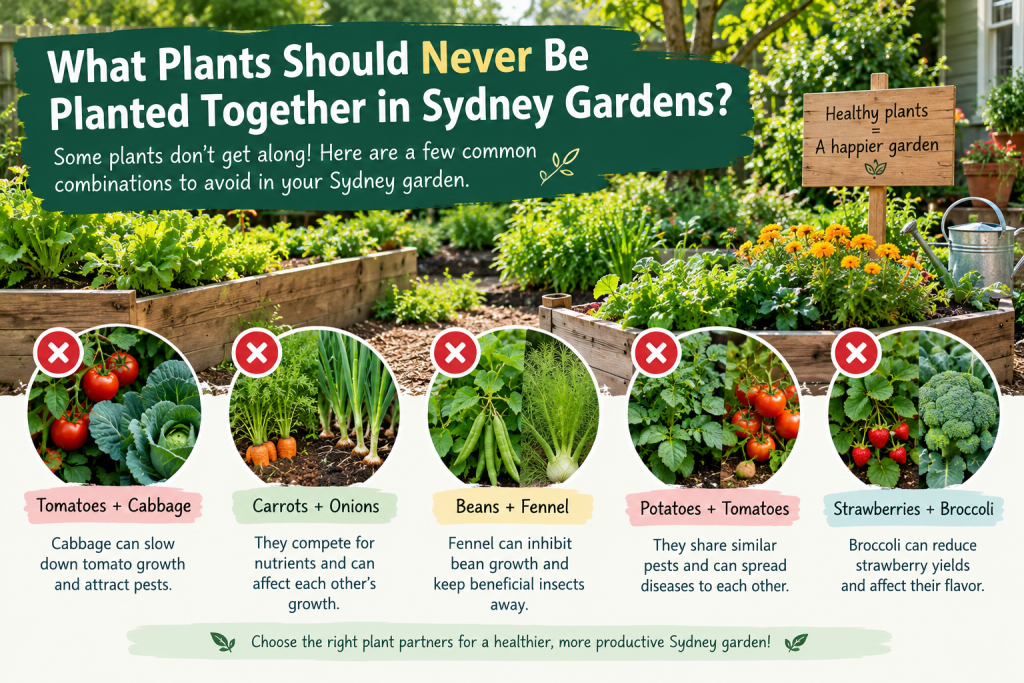
Quick Answer: 15 Plant Combinations to Treat With Caution
| Combination | Main concern | Better approach |
|---|---|---|
| Mint + parsley | Vigorous growth and competition | Grow mint in a container |
| Fennel + most vegetables | Possible growth suppression and competition | Give fennel its own area |
| Black walnut + sensitive plants | Juglone-related allelopathy | Keep a generous buffer |
| Eucalyptus + thirsty vegetables | Root competition and shade | Separate from food beds |
| Pine + shallow-rooted vegetables | Shade, litter and possible allelopathy | Keep garden beds away |
| Bamboo + small shrubs | Aggressive root/rhizome spread | Use controlled planting |
| Wattle + delicate seedlings | Competition and possible chemical effects | Allow space |
| Tomato + potato | Shared disease risk | Separate beds |
| Tomato + corn | Pest and resource competition | Avoid dense planting |
| Beans + onion family | Different growth needs | Separate where practical |
| Brassicas + tomatoes | Competing space and feeding needs | Rotate and space carefully |
| Fennel + beans | Competition and possible inhibition | Plant separately |
| Sunflower + sensitive vegetables | Shade and possible allelopathy | Position on the northern side |
| Large fruit trees + vegetables | Root, water and shade competition | Use a dedicated orchard zone |
| Aggressive groundcovers + small plants | Smothering and competition | Contain or remove spreading species |
Important: These are not all absolute botanical incompatibilities. Garden performance depends on cultivar, spacing, soil, water, weather, and management. Treat the list as a practical guide rather than a rigid rulebook.
1. The Biggest Problems Behind Bad Plant Combinations
Before looking at individual combinations, it’s worth understanding the mechanisms involved. Once you know what causes the problem, choosing suitable plant neighbours becomes much easier.
Competition for Water and Nutrients
Plants growing side by side share the same basic resources. In a small Sydney garden, that can become significant.
A vigorous plant with an extensive root system can consume water and nutrients faster than a smaller neighbour. This is particularly noticeable during hot or dry periods.
Sydney’s sandy soils can drain quickly, while clay soils may retain water but drain slowly. Consequently, a plant that is perfectly happy beside another species in a rich loam may struggle in a shallow sandstone-derived soil.
Large trees are an obvious example. A mature tree planted beside a vegetable bed can create intense competition for moisture and nutrients. Even if the vegetables receive enough sunlight, their roots may be operating in a very different environment from that of a raised bed.
Competition for Sunlight
Sun-loving vegetables generally need several hours of direct light to produce strong growth.
A tall plant can shade shorter crops, especially when it is placed on the northern side of a garden bed. In Sydney, thoughtful orientation matters because the angle and duration of sunlight change significantly through the year.
Sunflowers, corn, trees, climbing beans, and tall ornamental plants can all cast substantial shade.
This doesn’t make them bad plants. It simply means their position matters.
Shared Pests and Diseases
Two plants can also be poor neighbours because they attract the same pest or are susceptible to the same disease.
This is especially important when growing related vegetables. If one crop becomes heavily infected, a nearby related crop can provide another host.
That’s one reason crop rotation is useful. Moving plant families around the garden helps avoid repeatedly creating an easy target for pests and soil-borne disease.
Allelopathy: When Plants Chemically Affect Neighbours
Allelopathy sounds complicated, but the basic idea is straightforward.
Some plants release chemicals through their roots, leaves, flowers, or decomposing plant material. Those compounds may affect the germination or growth of other plants.
NSW gardening guidance recognises that some plants can release chemicals that suppress other plants. Royal Botanic Gardens Sydney material also discusses phytotoxic substances associated with some Acacia species and their potential role in reducing competition.
However, it’s important not to overstate this phenomenon. A plant isn’t automatically a poor companion simply because it has documented chemical interactions with other species.
In a backyard, physical competition, shade, water availability, and soil conditions are often much more important.
Space and Root Architecture
Finally, plants need room.
A small herb doesn’t have the same root architecture as a mature fruit tree. A spreading creeper doesn’t behave like a compact lettuce.
When designing a Sydney garden, consider the mature size of every plant rather than its size when you buy it.
That little pot of bamboo might look harmless today. Give it time, and you may have a very different story.
2. 15 Plant Combinations to Avoid or Separate
2.1 Mint and Parsley
Mint is famously vigorous. In favourable conditions, it can spread rapidly and occupy space that smaller herbs would otherwise use.
Parsley isn’t necessarily harmed by a specific chemical interaction with mint, but growing both tightly together can create a management headache. Mint’s spreading habit can crowd parsley and make harvesting awkward.
Better solution: grow mint in its own pot or a contained garden section.
This is one of those cases where separation isn’t about botanical warfare. It’s simply good garden design.
2.2 Fennel and Most Vegetable Crops
Fennel is one of the classic plants gardeners are cautious about placing directly into mixed vegetable beds.
Its large size also creates considerable competition. Fennel can become tall and bushy, casting shade over smaller crops.
Rather than squeezing fennel into a crowded vegetable patch, give it a dedicated position.
It can still be an attractive addition to the garden, and its flowers can provide resources for beneficial insects. The key is keeping it from dominating a productive bed.
2.3 Black Walnut and Sensitive Plants
Black walnut is a well-known example of allelopathy because it can produce juglone, a compound that can inhibit some plants.
Black walnut isn’t one of the first trees most Sydney gardeners think of, but the principle is worth understanding if you’re growing one or considering unusual fruit and nut trees.
Don’t assume every plant will fail beneath it. Instead, observe the species involved and leave a sensible root-zone buffer.
For a small urban garden, planting a large tree with strong competitive effects beside a vegetable bed is usually unnecessary trouble.
2.4 Eucalyptus and Small Vegetable Beds
Eucalypts are an iconic part of the Australian landscape, and many are excellent choices in appropriate Sydney landscapes.
The problem comes when a large eucalyptus is planted too close to a small vegetable patch.
The tree may eventually create shade and compete for water and root space. Its falling leaves and branches can also change the conditions beneath the canopy.
This doesn’t mean eucalyptus and vegetables can never coexist. It means scale matters.
If you’re designing a new garden, allow large trees enough room to mature.
2.5 Pine Trees and Sensitive Garden Plants
Pines can create difficult conditions for some underplantings through shade, root competition, litter, and changes to the soil surface.
The issue is often less dramatic than internet gardening lists suggest. Still, a dense vegetable garden immediately beneath a large pine isn’t an ideal arrangement.
If you want productive vegetables, choose an open position with appropriate soil, drainage, and sunlight.
2.6 Bamboo and Small Shrubs
Bamboo is another classic case where the problem is often physical rather than chemical.
Some bamboo species spread through vigorous rhizomes. Once established, they can compete aggressively with neighbouring plants and become difficult to remove.
NSW biosecurity guidance warns that plants capable of spreading vegetatively can become difficult garden weeds under suitable conditions.
If you want bamboo, research the particular species and its growth habit before planting. Containment is particularly important in small suburban gardens.
2.7 Wattle and Delicate Seedlings
Some Acacia species can influence neighbouring plants through competition and potentially phytotoxic compounds. Royal Botanic Gardens Sydney research notes that some Acacia species may reduce competition through phytotoxic substances from roots or leaf litter.
Again, don’t take this to mean every wattle is incompatible with everything else.
The practical lesson is simpler: large, established trees and tiny vegetable seedlings shouldn’t automatically share the same cramped root zone.
Give seedlings their own well-prepared bed and maintain sensible distances from mature trees.
2.8 Tomatoes and Potatoes
Tomatoes and potatoes belong to the same botanical family and can share some pests and diseases.
That doesn’t mean they can never grow in the same garden. However, planting them side by side makes it easier for problems affecting one crop to become a problem for the other.
Separating them, particularly in a productive garden with recurring disease issues, is a sensible precaution.
2.9 Tomatoes and Corn
Tomatoes and corn can coexist, but they aren’t always an ideal pairing in a small garden.
Both can become substantial plants. Corn can compete for nutrients and water while also creating shade.
There’s another concern: some pests can use multiple crops in the same growing area.
If space is limited, you’ll often get better results by giving each crop enough room for airflow and sunlight rather than trying to cram everything into one bed.
2.10 Beans and Onion-Family Crops
Beans and onions, garlic, and related crops are sometimes separated in companion-planting systems.
The important point is that “don’t plant together” claims vary widely depending on the source. There isn’t a simple scientific rule saying these plants can never coexist.
If your garden has limited space, observe how the combination performs rather than treating an online compatibility chart as gospel.
Spacing, sunlight, soil fertility, and irrigation may matter much more.
2.11 Brassicas and Tomatoes
Cabbage, broccoli, kale, cauliflower, and tomatoes have different growth patterns and nutrient demands.
Putting large plants too close together can create competition and reduce airflow.
Brassicas also benefit from careful pest management, so overcrowding them with other large crops can make inspection and maintenance harder.
Use generous spacing and consider rotating crop families between beds.
2.12 Fennel and Beans
Fennel deserves another mention because it can become a dominant plant in a small vegetable garden.
Beans, meanwhile, need adequate sunlight and space to climb or spread.
Rather than gambling on whether the interaction will be problematic in your particular soil, place fennel elsewhere.
This is a recurring theme in successful gardening: sometimes the simplest solution is simply to give plants their own space.
2.13 Sunflowers and Short Vegetables
Sunflowers can be spectacular, but they’re tall.
If planted on the southern side of a vegetable bed, they may cast useful afternoon shade in some situations. Put them on the wrong side, however, and they can deprive smaller plants of valuable light.
This is why garden orientation matters.
Think of the mature plant as a three-dimensional object, not just a dot on a planting diagram.
2.14 Large Fruit Trees and Vegetables
Fruit trees and vegetables can coexist, but their root systems and canopies need consideration.
A young citrus tree may appear to leave plenty of space for lettuce. Years later, its canopy may shade that same bed, while its roots occupy much more of the available soil.
If you’re establishing an orchard-style garden, keep the main vegetable beds separate where possible.
You can then manage irrigation, mulch, fertilising, pruning, and soil preparation according to each plant’s needs.
2.15 Aggressive Groundcovers and Small Plants
Some spreading plants can overwhelm slower-growing neighbours.
NSW WeedWise notes that invasive groundcovers such as Singapore daisy can form dense mats, compete with vegetable crops, and outcompete native plants.
This is an important distinction: sometimes the question isn’t “Are these two plants chemically incompatible?” It’s “Will one plant eventually smother the other?”
If the answer might be yes, containment is the safer choice.
3. How to Design Better Plant Partnerships in a Sydney Garden
Start With Your Soil
Don’t choose companions before understanding the growing conditions.
Sydney has both sandy and clay soils, and many local soils are acidic.
A simple soil test can tell you much more than a generic companion-planting chart.
Check:
- Soil pH
- Drainage
- Organic matter
- Moisture retention
- Compaction
- Available planting depth
If you have heavy clay, avoid working it while it’s wet because this can damage soil structure and cause compaction. NSW Environment guidance recommends maintaining organic matter and mulch as part of healthy soil management.
Match Plants by Water Needs
A drought-tolerant herb and a thirsty vegetable don’t necessarily belong in the same irrigation zone.
Grouping plants with similar water requirements makes maintenance easier.
For example, create separate areas for:
- Moisture-loving vegetables
- Mediterranean-style herbs
- Drought-tolerant natives
- Fruit trees
- Shade-loving plants
That approach often works better than trying to find a perfect companion for every plant.
Group Plants by Mature Size
Always check mature height and width.
A garden centre plant may be only 30 centimetres wide when purchased. That doesn’t mean it’ll stay that way.
Allow space for:
- Root growth
- Canopy spread
- Air circulation
- Harvesting
- Pruning
- Maintenance access
Your future self will thank you.
Use Companion Planting for Practical Reasons
Companion planting can be useful when it’s based on a clear mechanism.
Hornsby Shire Council’s companion-planting guidance describes several useful relationships, including plants that attract beneficial insects, provide shade, suppress weeds, or help deter certain pests.
For instance, flowering herbs can help create habitat for beneficial insects. NSW Environment guidance similarly recommends flowering plants and herbs to provide food for insects such as ladybirds and lacewings.
Instead of asking, “Is this plant a good companion?”, ask:
What job will this plant perform here?
It might provide:
- Pollinator habitat
- Shade
- Ground cover
- Pest confusion
- Wind protection
- Structural support
- Organic matter
- Food production
That’s a much more useful way to plan.
Don’t Ignore Biosecurity
Plant compatibility isn’t only about whether two plants grow well together.
You also need to consider whether a plant could become invasive.
NSW Government guidance notes that some common garden plants can become weedy in particular regions and recommends checking local conditions before planting.
For Greater Sydney, NSW WeedWise provides a regional list of priority weeds and biosecurity information.
NSW WeedWise — Greater Sydney weed information
A Simple Sydney Planting Formula
For a mixed backyard garden, try this approach:
| Garden zone | Suitable strategy |
|---|---|
| Vegetable beds | Group crops by family and season |
| Herb garden | Group by water and sunlight needs |
| Fruit trees | Give trees generous root and canopy space |
| Native garden | Select species suited to local soil and conditions |
| Small pots | Use containers for aggressive herbs |
| Shady areas | Choose shade-tolerant plants rather than forcing sun lovers |
| Wet areas | Select plants adapted to moisture |
| Dry areas | Use drought-tolerant species and efficient irrigation |
This approach is much more reliable than relying on a single “good companions/bad companions” chart.